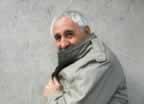
May 13, 2011
"Green light Go" by Simone Federman
 Simone & Raymond Federman
The Coliseum
My eyes were as bottomless as his, hollowed in my tiny face. And my mouth was almost more jaded - perfecting the scowl of a French-movie gangster, the attitude, if not the accent, that made him so charming. I would have smoked Gauloises in the car if he'd let me, the way he did, with the windows rolled up so his hair wouldn't blow, as we cruised the town, partners in crime, till Mom got home.
My mother sparkled with Hollywood sunlight, whereas my pop and I flickered in the shadows of the place where we lived when she was not around, where all his stories and the movies he'd taken me to from the time I was born converged. Errands were just an excuse for a stake-out; a trip to the bank, casing the joint for the big heist "the Organization" had planned.
Our swarthy complexions suited our roles as the good kind of bad guys, though I was more of a cowboy than he was, with half a half-gallon hat in the back seat to prove it, and he admired that about me. I was, after all, a real American, unlike him.
"Zoot, alors!" he'd say, forced to stall at a red light, and I'd take aim with my pistol finger tip, waiting until just the right moment - "Pow" - to shoot it green.
I love you Pop, miss you so much. Happy Birthday - Simone
Blogmaster's Note: Sunday is Ray's birthday.
Labels: A LA QUEUE LEU RAYMOND FEDERMAN, Simone Federman


January 21, 2011
SHHH

December 19, 2009
Free New Federman

"LIST OF SCENES FROM MY CHILDHOOD TO BE WRITTEN" by Raymond Federman
http://www.viceland.com/int/v16n12/htdocs/list-of-scenes-of-my-childhood-260.php
An excerpt from the forthcoming Starcherone Books novel, SHHH: THE STORY OF A CHILDHOOD, in the current VICE MAGAZINE, "The Fiction Issue."
October 21, 2009
You are invited to a celebration of the life of Raymond Federman

November 29th 5:00 PM
Bernardo Heights Country Club
16066 Bernardo Heights Parkway
San Diego, California 92128
Phone: 858-487-4022
Rsvp: moinous@federman.com
October 09, 2009
FROM SIMONE FEDERMAN (October 6, 2009)
 October 6, 2009
My father died this morning. Last night I read all of "The Voice in The Closet" to him in one breath, 75 pages: one sentence. I stopped on page 61 to cry, and then we both cried at the end.
He had not been responsive for more than 24 hours, so this was especially magical. I thanked him for all the books, all the beautiful sentences, this being the most beautiful I had ever read. I thanked him for being the best father I could ever imagine. I told him he would always be my best friend. His eyebrows told me to stop crying. So I did. I told him I understood because he had taught me about laughter.
I went to bed on the pull-out couch next to his bed. I half heard his loud heavy breathing stop and roused to call my mom, who had already had a beautiful tearful last goodbye, and the nurse. He had died. We said kaddish for him at the mortuary, and he was cremated, as he wished, like his mother, father and sisters, at about noon.
We are planning to spread some of the ashes, maybe some noodles too, at his golf course, maybe even make a drop at the casino, and then bring some to France to spread at his former apartment and Le Cimetière Marin (the one in the Valéry poem he wanted me to read to him last week).
My mother and I, my sister Robin and brothers, James and Steve are planning a memorial celebration of his life in San Diego in the coming weeks, details to come.
We are okay, feeling strong. We had a really special last few weeks with him, not to mention a really special 47 to 49 years. I apologize for the group e-mail. I just wanted you to know.
Much love,
Simone
 Le 6 octobre 2009
Mon père est mort ce matin. La veille je lui ai lu tout "La Voix dans le débarras" d’un seul trait, 75 pages : une phrase. Je me suis arrêtée à la page 61 pour pleurer, et ensuite on a pleuré ensemble à la fin.
Cela faisait plus de 24 heures qu'il n'avait plus réagi, c'était donc particulièrement magique.
Je l'ai remercié pour tous les livres, toutes les belles phrases, celle-ci étant la plus belle que j’ai jamais lue. Je l'ai remercié d'être le meilleur père que je puisse imaginer. Je lui ai dit qu'il serait toujours mon meilleur ami. Ses sourcils m'ont dit d'arrêter de pleurer. Donc je l'ai fait. Je lui ai dit que je comprenais parce qu'il m'avait tout appris sur le rire.
Je me suis couchée sur le clic clac à côté de son lit. J'ai entendu à demi sa respiration lourde et bruyante s’arrêter. Je me suis levée pour appeler ma mère, qui lui avait déjà dit un bel et tendre dernier adieu, ainsi que l'infirmière. Il était mort. On a dit le kaddish pour lui à la morgue et il a été incinéré, comme il l'avait souhaité, et comme sa mère, son père et ses sœurs l’avaient été, aux alentours de midi.
Nous avons pour projet de disperser quelques unes des cendres, et peut-être aussi quelques nouilles, sur son parcours de golf, de peut être même passer en laisser quelques unes au casino, et d'en apporter ensuite certaines en France pour les étendre dans son ancien appartement et au Cimetière marin (celui dans le poème de Valéry qu'il a voulu que je lui lise la semaine dernière).
Ma mere et moi, ma soeur Robin and frères James and Steve allons organiser une célébration commémorative de sa vie à San Diego dans les semaines prochaines, les détails suivront.
Nous allons bien. Nous venons de passer quelques semaines vraiment magnifiques avec lui, sans compter 47 à 49 années non moins magnifiques. Veuillez m'excuser pour cet e-mail de groupe. J'ai juste voulu vous mettre au courant.
Je vous embrasse,
Simone
October 06, 2009
Raymond Federman (1928-2009)

August 14, 2009
New from BlazeVOX [Books] — THE CARCASSES: A Fable (Paperback) by Raymond Federman
 — but she knows from her experience on planet Earth that even if she denounces her comrades she will be thrown on the pile of carcasses known as the pile of eternally rejected carcasses — it is the worse condition — the most terrible fate for a carcass is to know that she will never be transmuted — that there is no hope of ever be transmuted — not even as an ugly vegetable — let’s say as a carrot — or as a ridiculous object like a chamber pot — meanwhile the secret forces of the authorities — known as the authoritarian militia — are in the process of arresting all those who are involved because even if the NAFC did not give their names -- the OFCS denounced them — no need to say more about the pathetic failure of this revolution — what will happen in the zone of the carcasses will be told in a subsequent chapter — but as it is now said and repeated in every corner of the zone since the miscarriage of this revolt — the more things change the more they’re the same —
ORDER THE CARCASSES HERE
July 29, 2009
final escape
the final exitus
will it be violent
will it hurt
or will it be quiet
full of silence
will the sordid images
that have haunted us
be suddenly erased
or will they be replayed
endlessly replayed
in virtual reality
will we fall
or will we rise
or simply pass through
as one goes through
an open door
to enter a room
perhaps it will be
an escape
another escape
from the little box
where it all started
among empty skins
but this time it will be
the final escape
from the great cunt
of existence
and this time
without any gurgling
will the stolen sugar be
as sweet as the first time
and what of the moon
tiptoeing on the roof
will she smile upon us
or remain indifferent
will there be words
left to describe what
is taking place
words and silences
or will there be only
cries and whispers
Raymond Federman
June 13, 2009
voici les carcasses
.jpg)
June 01, 2009
my lovely daughter Simone wrote my obituary
So here it is the first of many reflections,
ah federman already with the evasive pretensions what do you mean reflections? you mean to say obituary
- No he is still living, very much living, he played golf the other day, went to the casino, won ten dollars, for god’s sake- do you think he would like you mentioning that god guy
- oh he wouldn’t mind he is very open minded at this point
- you did say his name in vein
-oy now you too.
So as I was saying I imagine I will write stuff
–better-
like this over and over but upon reflection I realized Federman himself would be the one who would most like to read it, so why wait? Like an espionage agent, he would love to be able to get a glimpse of what is being said about him once he isn’t saying it anymore. Those of you that know him know all too well this is true. So Pop this is for you too. These comments are open to your reflections upon them, edits, critiques, response or even silence
- That would be very uncharacteristic.
– Can’t you find another format for your digressions? The lack of punctuation and these italics interruptions may irritate the reader.
-His readers are extremely patient with all sorts of hijinks
- This is important, the guys fucking obituary after all. Shouldn’t you be more serious and sincere?
- Without the digressions I might wax sentimental and maybe even grim
- That would really bug him he hates those two things
- True, he has spent his life making a point of, an oeuvre of, not talking about the dead at least not sentimentally for god’s sake
- there’s that g-man again
- okay you made that point, let’s carry on
- carry on.
-Shouldn’t we first acknowledge the fact that this whole style thing is bald faced plagiarism
- He spells it playgerism; anyway, he likes that mostly when it is from le source.
- Ah le source, yes, he likes that, the blood, the Federman line, the lineage.
- Hey this is my obituary now you are hijacking it, write your own.
- Oh come on, we can share this one. go on where were we, sorry, I mean you? Oh. Wait! before you go on blame him for the fucked up punctuation and the way it is hard to understand who is talking. Remember you tried to correct it when you worked on sssh but he was stubborn about it. This dramatic dialogue format works well.
- He wasn’t very stubborn we had a great time working together. It made me feel so proud to be his daughter.
-Okay I think we are back to where you need to be, watch the tears though, he hates that and you are getting the keyboard all wet!
Raymond Federman means many things to many people. Hundreds if not thousands of people love him very much, will mourn his passing with profound sorrow. For me it is beyond comprehension. He is my Pop, my best friend, always has been for the last forty six years. Maybe before but I wouldn’t know,
- Ah so you’re thinking you are a fictitious fabrication?
- Only he would know because he is older than I am. He was there before I knew I was.
- He doesn’t always act it, older that is.
- This is not the place for insults.
- It was a loving joke, not an insult; his youthful exuberance is one of his best traits why don’t you mention that.
- I will if you could just control the interruptions, I was just getting on a roll
-d’accord, go ahead.
- Even if he said we had been friends, best friends more than forty six and a half years he might be lying; he is not a very reliable story teller
- You could ask your mother she is more grounded in reality
- Really you think so?
- Okay maybe not, but she has sure helped him.
- As his mother would say “he always has his head in the clouds”
- Well, that is what you say he says she said.
–True that but so it is written, as they say...
So Pop, my Pop and I ARE CLOSE, REAL CLOSE.
-wHOA that was weird why did everything go big all of a sudden? For emphasis?
- No I just hit the “CapsLk” key instead of the shift key I do it all the time.
- You don’t type very well, do you think that is because of all the afternoons you spent in his office after school writing concrete poetry on his IBM Selectric
- Yes the one with the ball, maybe…
He was so loving those afternoons in his beautiful office, on the old campus on Main St. He always made me feel like those poems I wrote, most of them just letters all garbled up not even words, were really brilliant. He has always made me feel like I am brilliant. I hated it when the ball would get jammed. He seemed so smart the way he could get me rolling again making that sound I loved so much. I would hear that sound all the time, the sound of the Selectric.
I used to love the sound when I would hear it stop upstairs on the third floor and then the best sound of all, the sound of his feet gliding down the edges of the stairs as he flew down the stairs, down to the second floor where I was often playing. I used to practice sliding down the front of the steps real quickly like him. I don’t know if it was practice I think I just am a lot like him
- You still are.
- I know, sad isn’t, I will miss him so much.
- Oh don’t start your crying again, “stop your balling” as Patsy would say
- I had terminal cancer I had good reason to cry
- You and your excuses, I suppose you think you have good reason now too, finish your story…
Where was I, where am I going with this? I guess I could start describing the most vivid memories I have of our time together. Being that he is still living and I talk to him every day, usually a few times a day I should probably use the present tense. It may be confusing, this living obituary style is a new form.
- The quotation marks he would have hated, don’t you think?
- Probably, but they do come in handy. Present tense!!..
The last time I saw him he tried to shoot the traffic light like he always did when we were in the car together which was often. He could shoot the light and make it turn green. His aim was not always good but he would just try again and again and eventually he always hit it. I think what is so remarkable about that was the frequency with which he played that game and still does. And every time I still feel amazed by the magic.
- While ridiculing his silliness. Not the last time you saw him forever just most recently.
-This tense shit makes me tense…
I loved our outings. Every Sunday morning we would drive to the drugstore to pick up the New York Times, it is only as an adult I realized it could be delivered. My Pop would buy Gauloises, often a carton always non filtered. He would give me my dollar allowance and I would shop for a Hot Wheel car for my collection. At the cashier he would pretend he didn’t have any more money when I asked him for the $.06 I needed to complete my transaction. The Hot Wheels cost $. 99 with tax $1.07. He always said he didn’t have it he always gave it to me anyway. He still does. He usually says he can’t afford anything then he is very generous, extravagant even.
If my mother asks him to bring her a drink of water he always says “Non” as he reaches for the glass
- What a character, an idiosyncratic individual. Give another example…
When he sees a view he likes to
- Not likes to, it is he can’t control himself.
-Good point- now shut up for a minute...
When he sees a view he goes “Oh lala!” a really great view gets “Oh lalaOhlala merde c’est formidable!” always with a “regarde Simone, regarde Erica!” There was a trip when the three of us drove across Europe. We would stop at many, many view platforms or rather places on the side of the road and he would make us get out of the car and he would always let out an “ Ohlala” sometimes with an exclamation point kind of loud and operatic “Ohlala, Ohlala!” sometimes soft and slow, quietly no exclamation point.”ohlala,olalaola” I used to count how many refrains he would make and I decided the most were at Kotor Yugoslavia. We were on a curvy road up above the village of Kotor. I don’t remember how many “ohlalaOhlalaOhlala”s occurred but it was a lot, believe me, the most ever. I was almost in more awe of his persistence than the view but it was very beautiful. I remember that view, that day very clearly for some reason. Maybe it is because one year later I read in the paper maybe saw it on TV; there had been a horrible earthquake in Yugoslavia and a road had collapsed on a tiny village named Kotor. It was completely destroyed, vanished.
- You still have your memories.
- Oh don’t be trite. This isn’t a sappy movie. I am dealing with the most difficult thing I have ever had to deal with in my entire life, worse than my own illness. I am trying
- You are doing a good job. I’m sorry. It is really hard for me too you know.
On that trip we had a project: to kept track of the best crème caramels in the world. We were the self appointed judges of the European Crème Caramel Competition. We tried them everywhere and ranked each one we tested.
- So which one won, our readers might like to know, this book might actually contain some worthwhile information.
The Best Crème Caramel was definitively anointed at a small restaurant in France- bien sur called Hotel Luberon, I think that is the name of the town too. Might be misspelled
- Maybe you should look it up while I write this damn obituary before we all die!
Mom most likely found the place in the Michelin guide. I think they might have had a bottle of some fancy wine from 1928 that night too. I remember that because that is the year he was born.
-I am starting to think you are making this stuff up!
-Okay maybe that wasn’t the same meal but it was the same trip and his birth date is documented. There are documents, I have seen his birth certificate that he found in the little closet in the bedroom when he went back to the apartment after the war. (Read about it in ssh due in bookstores fall’09) Anyway, what does it matter he won’t remember and makes stuff up all the time.
-He has no memory just fictitious fabrications.
-Is there really any difference?
- Of course not, that much he taught you.
Maybe this would be a good place to insert my published piece Mon Pere le Fictionare
– You are starting to throw in an awful lot of advertisements don’t you think? French no less!
- That’s true it is published in both languages.
-This insertion stuff is so derivative too, it was confusing enough when he did it all the time in Sssh. I thought you were trying to avoid his preclusions
- I think it is too late for that
- Besides your readers have probably already read that damn piece in French or English or heard it at your slide show in Buffalo, you are bugging me a bit the way you are so much like him, kind of creepy
- Oh relax, they can skip over it if they want.
- Well then include the slide show narration, and then the publisher can throw in the photos, people like that. Besides you will probably have a wider readership than he ever did with those Federman A to XXXX books.
- True he is bound to get really famous posthumously.
- Always happens.
- Sad isn’t it he always wanted the notoriety, acclaim.
- He did pretty well for himself.
- Yeah but he wanted to write that one great book the one he would be remembered for.
- Oh he will be remembered no question.
- He wrote a great story in the form of many books.
- Like Proust? Beckett?
- No even better he wrote them like Federman.
- No one like him, just one Federman.
- No one but you.
- True but I think he would be happy I was riding on his coattails.
- He always wa..is so proud of you.
-I love him so much.
- Me too.
-I know you do.
-Is that it? Are we done?
-For now. He isn’t dead yet silly.
-Good point. Done with this installment then.
May 23, 2009
Novelist Raymond Federman Honored at Washington College's 2009 Commencement, May 17

Chestertown, MD — National Public Radio's Diane Rehm, a living legend of broadcast journalism, addressed the graduates at Washington College's 2009 Commencement ceremonies on Sunday, May 17. Rehm received an honorary degree in addition to being guest speaker at this year's Commencement.
French-American novelist Raymond Federman received an honorary Doctor of Letters along with Rehm, and addressed the graduating class.
Raymond Federman is a French-American novelist and academic, known also for poetry, essays, translations and criticism. He held positions at the University at Buffalo from 1973 to 1999, where he is now Distinguished Emeritus Professor.
Federman is a writer in the experimental style, one that seeks to deconstruct traditional prose. This type of writing is quite prevalent in his book Double or Nothing, in which the linear narrative of the story has been broken down and restructured so as to be nearly incoherent. Words are also often arranged on pages to resemble images or to suggest repetitious themes.
Born in Montrouge, France, Federman emigrated to the U.S. in 1947. He studied at Columbia University and as a graduate at U.C.L.A., where he earned a doctorate in comparative literature on Samuel Beckett. He is also a co-founder of the Fiction Collective, a publishing house dedicated to experimental fiction and its writers.
May 12, 2009
A Matter of Enthusiasm
 I am rereading Malone Dies
just to mock death a little
and boost my cancerous spirit.
I shall soon be quite dead at last
Malone tells us at the beginning
of his story.
What a superb opening
what a fabulous sentence.
With such a sentence
Malone announces his death
and at the same time delays it.
In fact all of Malone’s story
is but an adjournment.
Malone even manages
to defer his death
until the end of eternity.
That
soon is such a vague word.
How much time is soon?
Hoe does one measure soon?
Normal people say
I’ll be dead in ten years
or I’ll be dead before I’m eighty
or I’ll be dead by the end of this week
Quite dead at last
Malone specifies.
Unlike Malone prone in bed
scribbling the story of his death
with his little pencil stub
normal standing people
like to be precise
concerning their death.
Oh how they would love
to know in advance
the exact date and time
of their death.
How relieved they would be
to know exactly when
they would depart from
the great cunt of existence
in Malone’s own words
to plunge into the great lie
of the afterlife.
How happy they would be
if when they emerge into life
the good doctor
or the one responsible
for having expelled them
into existence
would tell them you will die at 15:30
on December 22, 1989.
Could Sam have written
I shall soon be quite dead at last
had he known in advance
when he would change tense?
Certainly not
because as Malone tells us
a bit further in his story
I shall die tepid
without enthusiasm.
Does that mean on the contrary
of those idiots on this bitch of an earth
who explode themselves with fervor
to reach the illusion of paradise
while taking with them other mortals
that Malone’s lack of enthusiasm
towards his own death is a clever way
of delaying the act of dying?
A lack of enthusiasm for something
is always a way of postponing
the terms of that something.
The soon of Malone mocks
the permanence of death
and his lack of enthusiasm
ridicules the expression at last.
And so before he reaches the end
of the first page of his story
Malone has already succeeded
in postponing his death to
Saint John the Baptist’s Day
and even the Fourteenth of July.
Malone even believes he might be able
to resist until the
Transfiguration
not to speak of the Assumption
which certainly throws some doubt
as to what really happened
on that mythical day
or what will happen to Malone
if he manages to hang on until then.
In fact Malone defies his own death
by giving himself
birth into death
as he explains at the end of his story.
All is ready. Except me. I am being
given, if I may venture the expression,
birth to into death, such is my impression.
The feet are clear already,
of the great cunt of existence.
Favorable presentation I trust.
My head will be the last to die.
Haul in your hands. I can’t.
The render rents, My story ended
I’ll be living yet. Promising lag.
That is the end of me. I shall say I no more.
Nothing more to add this evening.
Malone said it all for me.
I can go to sleep calmly now.
Good night everybody.
Raymond Federman